
She was a QA engineer at a mid-sized e-commerce company that sold home fitness equipment. It was Black Friday weekend, traffic had doubled, and the recommendation engine was showing yoga mats to customers browsing dumbbells. Conversion rates dropped within hours.
By midnight, Lena sat with the product manager and a tired backend developer, trying to trace the issue. At first, they assumed it was a bug. Maybe a failed deployment or a bad data sync.
But the logs told a different story.
Nothing had technically “broken.” The system was working exactly as designed.
And that was the problem.
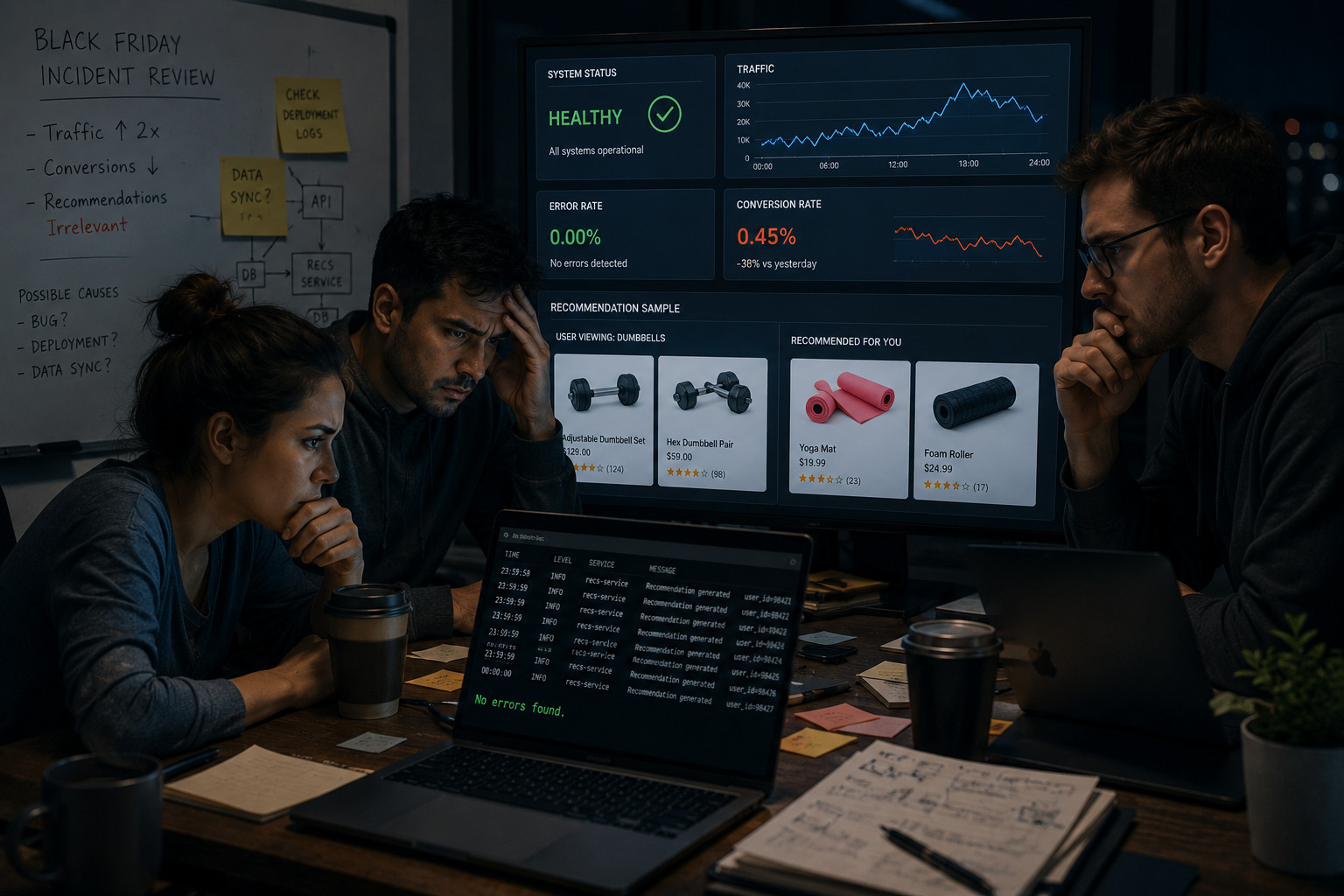
Their recommendation engine relied on fixed rules. If a user clicked on a category, it showed predefined related products. If they bought an item, it triggered a static list of suggestions. It didn’t adapt. It didn’t learn. It didn’t care that customer behavior had shifted overnight.
During normal weeks, this approach was “good enough.” But under real pressure, with thousands of unpredictable users behaving differently, the system started to fall apart.
Customers were browsing across categories, comparing products, jumping between fitness goals. The old logic could not keep up with that complexity.
The next morning, the product manager said something simple that stuck with Lena:
“We’re not failing because of bugs. We’re failing because the system doesn’t understand our customers.”
That was the moment the conversation shifted.
Instead of asking, “How do we fix this rule?” they started asking, “How do we make the system learn?”
A few weeks later, the team began exploring machine learning models. Not because AI sounded exciting, but because their existing system had reached its limit.
And that is where AI in e-commerce stops being a buzzword and starts becoming a practical solution to a very real problem.
What Is AI in E-commerce and Why It Matters
AI in e-commerce means using machine learning, data models, automation, and predictive systems to improve how online stores operate and how customers experience shopping.
It matters because customer expectations have changed. People expect fast answers, relevant product recommendations, simple checkout flows, and support that understands their problem without making them repeat everything.
According to McKinsey, personalization can lift revenue by 10 to 15 percent for companies that apply it effectively. That is not theoretical. It is measurable business value.
How to Use AI in E-commerce in Practical Ways
Smarter Product Recommendations
Lena’s team replaced their rule-based recommendation system with a model that analyzed browsing behavior, purchase history, and product relationships.
Within three months, click-through rates improved and average order value increased. The team did not need a massive AI lab. They needed a focused use case and clean enough data to learn from.
Dynamic Pricing
AI can help e-commerce businesses adjust prices based on demand, seasonality, inventory levels, and competitor activity.
This does not mean changing prices randomly. It means using data to make pricing decisions faster and more accurately than a human team could do manually.
AI Chatbots and Customer Support
Modern AI chatbots can answer product questions, help with order tracking, suggest items, and route complex issues to human agents.
Gartner has predicted that by 2027, 25 percent of customer service operations will use AI-powered virtual assistants. For e-commerce teams, this means support can scale without losing speed.
Inventory Forecasting
One developer on Lena’s team joked that inventory problems caused more stress than bugs. AI helped the company forecast demand, reduce overstock, and avoid running out of popular products during peak traffic.
Benefits of AI in E-commerce
The benefits of AI in e-commerce are not limited to automation. AI changes how teams make decisions, serve customers, and plan growth.
Key Insights
- AI helps businesses personalize the shopping experience.
- It improves product discovery through better search and recommendations.
- It can reduce support workload through automated assistance.
- It helps teams forecast demand and manage inventory.
- It supports faster, data-backed decision-making.
Amazon has reported that a large share of its sales comes from product recommendations. That shows how powerful personalization can be when it is built into the shopping journey.
How AI Improves the Online Shopping Experience
Customers usually do not think about AI directly. They notice when a website feels easier to use.
After Lena’s team launched the new recommendation system, one test participant said, “It feels like the site understands what I want.” That sentence became a quiet benchmark for the product team.
AI Improves Shopping Through:
- Relevant product suggestions
- Faster and smarter search results
- Personalized emails and offers
- Better product descriptions
- Quicker customer support
- More accurate delivery and inventory updates
Examples of AI in E-commerce
Amazon
Amazon uses AI for product recommendations, demand forecasting, search ranking, fraud detection, and logistics optimization.
Shopify Stores
Many Shopify merchants now use AI tools for product descriptions, email campaigns, customer segmentation, and automated chat support.
Zalando
Fashion retailers like Zalando use AI to support product discovery, visual search, and personalized style recommendations.
Small Business Example
A boutique online store might use AI to send personalized email campaigns. Instead of sending the same message to every customer, it can recommend products based on previous purchases and browsing behavior.
Best AI Tools for E-commerce Businesses
| Tool | Use Case | Best For | Complexity |
|---|---|---|---|
| Shopify Magic | Product descriptions and content | Small stores | Low |
| Klaviyo AI | Email marketing and segmentation | Growth teams | Medium |
| Algolia AI Search | Search and product discovery | Mid-sized and large stores | Medium |
| Dynamic Yield | Personalization | Enterprise retailers | High |
| ChatGPT API | Custom workflows and automation | Technical teams | Medium |
Practical Steps for AI Adoption
Lena’s team made a common mistake at first. They tried to build too much too quickly. Later, they learned to start smaller.
Practical Steps
- Choose one business problem to solve first.
- Start with a measurable use case, such as recommendations or support.
- Clean your product, customer, and order data.
- Use existing tools before building custom systems.
- Measure results before expanding.
- Keep humans involved in review and decision-making.
Limitations of AI in E-commerce
AI is useful, but it is not magic. It can fail when the data is poor, the goals are unclear, or the team expects instant results.
Common Limitations
- Poor data quality can lead to weak recommendations.
- AI tools can be costly if used without a clear plan.
- Teams may need technical skills to customize systems.
- Models can reflect bias from historical data.
- Over-automation can make the customer experience feel cold.
Andrew Ng, a well-known AI expert, once said, “AI is the new electricity.” The point is simple. Like electricity, AI needs infrastructure before it becomes useful. Without the right systems, it will not deliver meaningful value.
Pros and Cons of AI in E-commerce
| Pros | Cons |
|---|---|
| Improves personalization | Requires quality data |
| Reduces repetitive manual work | Can be expensive to implement |
| Supports faster customer service | May need technical expertise |
| Helps increase conversions | Can create poor experiences if overused |
Conclusion
A year after that Black Friday incident, Lena’s team looked very different.
The recommendation engine no longer relied on fixed rules. Customer behavior shaped it every day. The system adapted without constant manual updates.
One evening, while reviewing dashboards, Lena noticed something simple. The error logs were quiet. Conversion rates were stable. Customers were spending more time exploring products.
Nothing dramatic. Just steady improvement.
That is what AI in e-commerce often looks like in real life. Not a sudden transformation, but gradual progress built on better data, better decisions, and a clearer understanding of customers.
So the real question is this: is your business still reacting to customer behavior, or is it ready to start understanding it?
By Alexander White